
Star Stories
QuickLinks
📍 Find International Dark Sky Places here
📰 Read Native star stories here
⭐ Learn about “Star Basics” from NASA
📱 Bring awareness to the effects of light pollution with Globe at Night program
Curiosity
Dig deeper into reflections about the cosmos and the constellations. Learn more about Dark Sky Places and expand upon the card activities!
-
What might have made the constellations useful to people before electricity and other technologies like compasses that could help you find your direction?
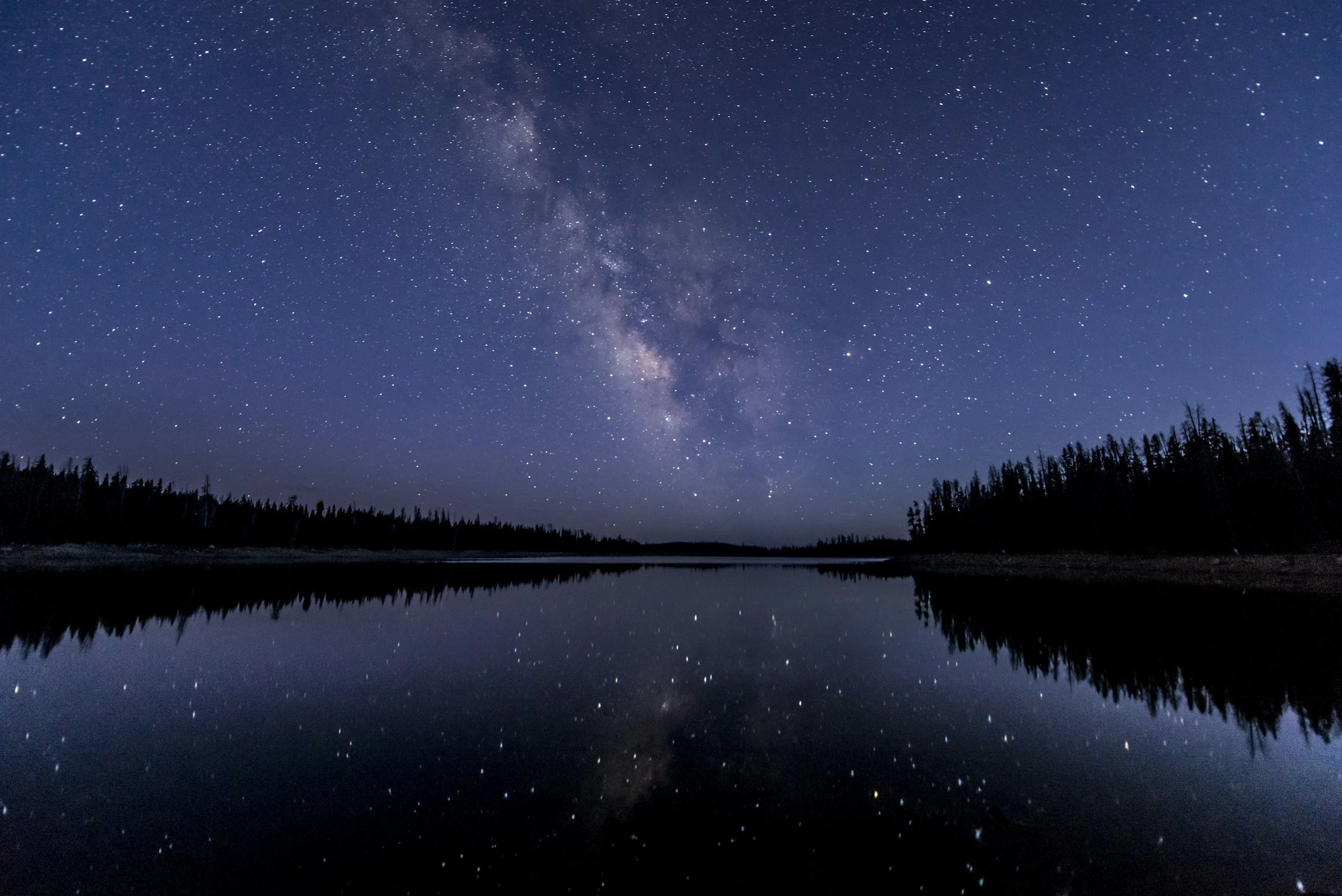
Have you ever heard of a “Dark Sky Place”? There are officially recognized International Dark Sky Places where there is minimal to no light pollution, allowing for an exceptional view of the stars and the cosmos.
Why do you think Dark Sky Places might be important?
What do you find special about a place where you can see the stars better? How does it feel compared to a place with light pollution, or other lights that block out the natural light from the stars and moon.
-
Count the Stars
Have you ever looked up at the sky and wondered how many stars are out there? Astronomers think that the universe might contain up to one septillion stars (that’s 1,000,000,000,000,000,000,000,000) and the Milky way could have over 100 billion. That’s way too many to count! But…you can try to count some stars.
The Goal:
See how many stars you can see when you are in a place with less light pollution. This doesn’t have to be a Dark Sky Place, but if you’re camping or out in nature, you’re less likely to have as much light pollution than in the city.
While You’re in Nature:
Take a piece of paper, fold it in half, and cut a small rectangle out of it. [INSERT A PICTURE]
Hold the rectangle up to the sky and close to your face.
Count the number of stars you can see with your naked eye.
Write it down and save the piece of paper and information for later
While You’re at Home:
Take the same piece of paper out
Replicate the process at home.
Write down the number of stars you see.
Reflection:
What is the difference between the number of stars you can see at home and out in nature?
Why do you think there is a difference (or no difference)?
-
What is light pollution?
Light pollution creates "skyglow," a hazy glow that obscures the stars and makes deep-space observation difficult or impossible. Because modern telescopes require extreme darkness to detect the faint light from distant galaxies, Dark Sky preserves are some of hte only places where observatories, or places with powerful telescopes.
Creativity
Connect with and create art from the night sky
-
The night sky has been the subject of many famous paintings. Check out these paintings and art pieces. What do you notice about the sky? Do you think the artist experienced the night sky differently from you?
Check out these images as inspiration:
⭐ Starry Night by Vincent Van Gogh
⭐ Starlight Night by Georgia O’Keefe (1917)
⭐ The Meteor of 1860 by Frederic Edwin Church (1860-61)
⭐ Moonrise, Hernandez, New Mexico (1941) by Ansel Adams
⭐ Seven Sisters Dreaming by Alma Granites (mid 2010s)
⭐ Nebra Sky Disc (800–1600 BCE)
Which one of these pieces of art inspires you? Create a painting or photograph of the night sky inspired by one of these pieces.
-
Believe it or not, your phone camera can capture pretty decent night sky photos. Here are some tips that you can use with your or your grown-ups camera:
Stay still–find something to mount your phone on or use a tripod: Because the exposure takes a lot longer in the dark, your camera will detect any movement and it will be blurry.
Put your phone in Night Mode: For iPhone, point your phone at the sky, and the Night mode (moon) icon will automatically appear. Tap the icon, and a slider will pop up at the bottom of the screen. Slide the exposure duration to the Max (30 seconds). On an android this might be called “Night Sight” by opening your camera app, swiping to Night, or look under the More tab. For Google Pixel, there is Astrophotography Mode, a specialized setting that triggers automatically when using Night Sight on a tripod to capture the night sky.
Lower the exposure or shutter speed: On the iPhone, after tapping the sky to focus, swipe down on the exposure slider (the sun icon) to darken the sky to around -1.0 or -2.0. This gets rid of unwanted haze and makes the stars pop against the dark backdrop.
Turn off the flash: If your phone doesn’t automatically do this, make sure to turn off the flash as it will be the only light it captures.
Framing: A photo of the night sky by itself is always beautiful, but try to include a larger image to give perspective. For example, if there is a big rock formation, have that formation on one side of the image. If there’s a forest, have the tops of the trees at the very bottom of the photograph.
Connection
Learn about how humans connect with the stars.
-
There is something special that comes from seeing your home planet from space—whether it’s in a picture or in real life. This is called “The Overview Effect.” Seeing the sheer scale of the Milky Way provides a unique educational perspective on Earth’s place in the universe, fostering a sense of global stewardship.
We saw the astronauts from the Artemis II Space Mission that flew around the moon experiencing “The Overview Effect” in real time. And their photos and transmits from space created the same effect in countless earthlings.
Check out these photos from the mission and think about what they make you feel about your home planet. What do these photos make you think about? What observations can you make from them?
-
For many Indigenous cultures across the globe, the stars are not distant, inanimate objects but living relatives, ancestors, and foundational maps for both physical and spiritual life. These connections are deeply rooted in "Original Instructions"—traditional knowledge passed down through generations that links the movements of the cosmos to the health of the Earth.
Traditional navigators use "star houses," where the rising and setting points of specific stars on the horizon provide precise headings.
-
Knowledge of the stars is kept alive through oral storytelling. These stories are rarely just "myths"; they are mnemonic devices that store critical data about survival, ethics, and law.
The Great Bear: Many Northern Hemisphere cultures have variations of a story involving a celestial bear (often associated with the Big Dipper), which explains the changing of the seasons based on the bear's hunt and eventual "rebirth."
Moral Maps: The stars also act as a moral compass, with constellations representing heroes or deities whose stories teach the community about bravery, humility, and the consequences of greed.
By viewing the cosmos as an extension of their community, Indigenous peoples maintain a relationship with the universe that is based on kinship rather than just observation. It is a holistic system where the sky, the land, and the people are part of a single, continuous story.
Read more of these Native stories as told by By Ire’ne Lara Silva inTexas Highways.
-
The stars serve as a sophisticated GPS. Because the stars remain in the same place, deep knowledge of the celestial skies provided a way for Indigenous peoples to navigate vast open spaces, especially those without many notable landmarks such as on the water and in deserts without modern instruments.
Poynesian Wayfinding – In the South Pacific islands where many people lived on small islands, traveling by ocean between islands was a necessity to trade and maintain contact with others. By reading the "star paths," navigators can travel thousands of miles across open water. (fun fact: Disney’s Moana is a Wayfinder)
Land Markers: Many North American tribes used the North Star ($Polaris$) or the Big Dipper to orient themselves during seasonal migrations across the Great Plains.
-
The appearance of certain constellations often signals the time for specific activities and events to happen in the community. For example the rising of the Pleiades (known as Matariki to the Māori in New Zealand or M45) often marks the beginning of the New Year or the optimal time to plant or harvest specific crops. And for some Arctic Indigenous groups, the position of the stars indicates when sea ice is safe for travel or when caribou migrations will begin.
Reflections:
Do you think the changing climate might change some of the way the seasonal calendars are looked at? How do you think communities are adapting?
-
Many Indigenous cosmologies view the stars as the literal place of origin for their people. This creates a reciprocal relationship where looking at the sky is an act of looking at one's history.
Example origin stories:
Numerous cultures, including various First Nations and South American Indigenous groups, describe the Milky Way as a "Spirit Path" or a river where the souls of ancestors travel.
In Lakota tradition, there is a profound belief in Wicahpi Oyate (The Star Nation), emphasizing that humans are made of the same "star stuff" and are spiritually tethered to the heavens.
Conservation
Maintaining our dark skies is an important part of conservation. Learn how you can help get involved.
-
Did you know that maintaining Dark Sky Places is an important part of conservation?
Most life on Earth evolved with a predictable rhythm of day and night–this is called the circadian rhythm. Artificial light at night (ALAN) disrupts the biological clocks of countless species.
How it affects plants and animals:
Migration: Many birds migrate at night using the stars for navigation. Artificial light can cause them to go off course or collide with illuminated buildings.
Reproduction: Species like sea turtles depend on dark beaches; hatchlings use the moonlight on the ocean to find the water, but artificial lights can draw them inland toward danger.
Pollination: Nocturnal pollinators, such as moths and bats, are often more efficient than daytime insects but are easily distracted or killed by artificial light sources.
For humans:
Sleep: Exposure to artificial light, especially blue light from all the screens we use, reduces the production of melatonin in our brain which is a chemical our bodies create to help with sleep. This can lead to sleep disorders and other health challenges.
Cultural Connection: For millennia, the stars inspired religion, philosophy, science, and art. Dark sky places preserve our "living history," allowing us to see the same constellations that guided ancestors and indigenous stewards of the land. (See our connection section for more information about the Indigenous connection to the cosmos)
-
Globe at Night is an international citizen scientist (average people participating in scientific studies and observation in the real world) program lets you participate in scientific observation of the night sky to help bring public awareness to the impact of light pollution.
How it works: citizen scientists (you!) take measurements of the light in the sky at different times at night.
Plan your dates: “Campaigns” happen for a period of ten days each month when the moon is at its least brightest. You can find out when the campaigns happen at https://globeatnight.org/campaigns. This page also includes some good start-hunting tips.
Timing: Measurements should be taken more than an hour after sunset.
Recording observations: Visit the Globe at Night WebApp to record observations.
What happens next: The data, or information, you record is collected in a large database that can be analyzed to show the effects of light pollution. Check out this map that shows the magnitude of light all over the world.
-
Here are some tips to limit light pollution at home:
Use light only when it is needed. Turn off lights in your homes when you’re not using them. Much of the light produced in cities is "uplight" that shines directly into the sky rather than onto the ground.
Change fixtures and bulbs: Shielding fixtures and using lower-intensity bulbs significantly reduces energy consumption and the carbon emissions associated with electricity production as well as creates less intense lighting.
Use warm color lights (get your grown-up on board): Avoid blue-rich white light (those lights that look like they are in an office building!), which scatters easily in the atmosphere and creates intense skyglow. Switch to long-wavelength bulbs with a warm amber, yellow, or red tint (ideally under 3000K, or better yet, 2200K).
-
Advocates help make change in their communities by helping to educate about an issue they care about. If you care about protecting our communities from light pollution, you can become and advocate through DarkSky International.
Help neighbors learn about light pollution and what they can do: You can distribute flyers or even talk to neighbors (in a friendly and respectful way!) who might have big floodlights. Focus on the benefits of shielding (saving energy, reducing glare, and creating a more restful environment) rather than blaming them. DarkSky International even offers printable friendly neighborhood outreach materials to help start the conversation.
Take the issue to your neighborhood organization or city council (they love to hear from kids!): First find out if your city or community has a lighting code. If it doesn't, you can work with community leaders and local astronomy clubs to propose a dark-sky ordinance. Many cities across the country have successfully updated their municipal codes to require shielded streetlights and commercial retrofits. Here are some resources from DarkSky International. (Keep in mind that lighting in cities is also for safety and there is often lighting that does not work for people with darker skin. So be aware of the safety needs, especially people most at-risk of being struck by vehicles at night).
Organize a “Night Walk” or “Star Party” with your school, park, or just some neighborhood friends: Find a park or a place where you have big, open sky and where there might be less light pollution and gather your friends and community members to look up at the stars for the night. This is a fun way to show people how cool the cosmos is and what we could lose when the night sky is over-illuminated.