
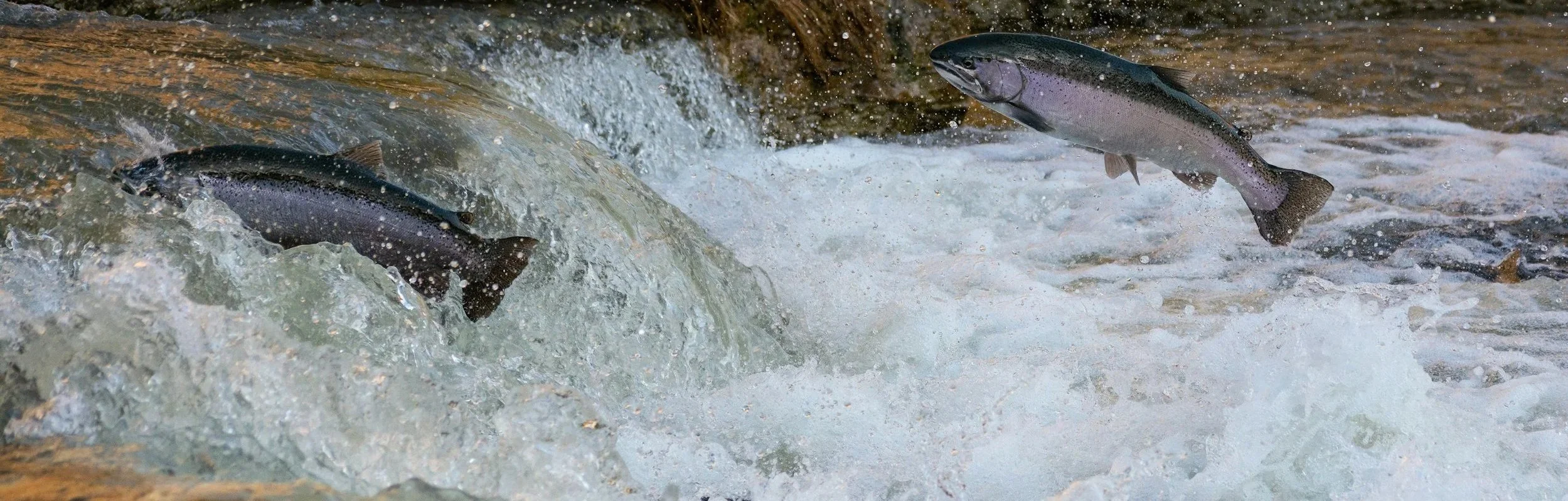
Salmon Splash
QuickLinks
📺 Check out the live feed of brown bears catching salmon at Brooks Falls! These bears eat the salmon, fattening them up for Fat Bear Week!
🌐 Keep up on Fat Bear Week every Fall, a single elimination tournament where the public votes on the fattest and most hibernation-ready (i.e. best salmon catcher of them all!) in Alaska’s Katmai National Park
🌐 Learn about the tribes who rightfully call themselves “The Salmon People”: Columbia River Inter-Tribal Fish Commission (CRITFC) and The Yurok Tribe
📱 Check out this app tracking watersheds
Curiosity
Keep the fun going
-
The Power of the Leap: Why do you think a salmon needs to burst out of the water and splash so high? What kinds of obstacles (like waterfalls or fallen logs) are they trying to climb over?
An Incredible Map: Salmon travel thousands of miles out into the ocean, but when it’s time to lay eggs, they find their way back to the exact freshwater stream where they were born. How do you think they navigate? (Hint: They use an incredibly powerful sense of smell!)
Swimming Up a Slide: Imagine trying to swim up a giant water slide while the water is rushing down against you. How much strength, stamina, and determination would that take?
-
While you are in NATURE
While in Nature: Finding the Eddies. Find a safe spot to observe a moving stream, river, or even a park water feature. Drop a small twig or leaf into the current and watch its journey. Look closely for "eddies"—the calm pockets of swirling water that form directly behind large rocks, logs, or bends in the river. Talk about how migrating salmon use these secret rest stops to catch their breath and save their energy before making their next big upstream splash.
While you are at HOME
Every single house sits inside a watershed—an area of land that catches rainfall and drains all its local streams and rivers down to a single common outlet, like a bay or an ocean. Where your neighborhood's water ends up depends entirely on what side of the Continental Divide you live on! This massive, high ridge of mountains acts as the ultimate natural drainage divide, splitting the continent's water flow. Rain falling on the east side of the divide flows down toward the Atlantic Ocean or the Gulf of Mexico, while rain on the west side travels toward the Pacific Ocean.
The Challenge: Print out a physical map of the United States
Here is a cool app that allows you to trace watersheds
Under ‘Options’ on the left-hand menu, choose trace flow path. Click on the map to see where the water goes!
Have your child find your home state or town on the map.
Grab a blue marker and trace the nearest blue river line outward. Follow the winding pathways as small creeks flow into larger rivers, tracking the exact path a local drop of water takes to reach the sea!
-
Super Sniffers and Navigators
Salmon have an unbelievable sense of smell—they can smell a single drop of scent in an area equivalent to ten Olympic-sized swimming pools!
Before migrating from their freshwater streams, young salmon imprint the exact smells of their surroundings. Years later, they use this memory as a GPS to find their way home.
Leaping and Racing
When returning upstream to spawn, salmon stop eating entirely and rely purely on stored energy.
They can leap up to 2 meters (about 6 feet) into the air to jump over obstacles like waterfalls and dams, a feat that rivals Olympic athletes!
A migrating salmon often travels up to 50 kilometers (31 miles) a day, which is the equivalent of running more than a marathon every single day.
Shape and Color Shifters
Salmon are true chameleons. Depending on their life stage and species, they shift from light-colored spots in the river to sleek, silvery-blue in the ocean.
When it is time to spawn, adult salmon completely change color—for example, Sockeye salmon turn brilliant red with bright green heads.
The Circle of Life
Most salmon die of exhaustion shortly after spawning, but their carcasses don't go to waste. They play a vital role as a keystone species by returning essential ocean nutrients back to the inland forests and sustaining over 100 other species.
Millions of years ago, prehistoric salmon were massive monsters—weighing up to 500 pounds, stretching 10 feet long, and sporting fangs!
Creativity
Let nature inspire you
-
Did you know that salmon are master shape-shifters? While living in the ocean, they are a sleek, camouflaged silver color. But when they enter freshwater rivers to journey home, their bodies transform into brilliant crimson reds and deep forest greens!
Have your child fold a piece of watercolor paper in half.
On the left side, use cool grays, blues, and metallic silver paints to depict a salmon's ocean life.
On the right side, use bold reds and emerald greens to paint its spawning transformation.
While the paint is still wet, sprinkle a pinch of household table salt across the paper. As the salt absorbs the water, it will dry into a beautiful, shimmering texture that looks exactly like glistening fish scales and river bubbles.
-
The salmon's splash is a heartbeat for entire ecosystems, carrying vital ocean nutrients deep into inland forests to feed bears, eagles, and the very soil itself. Indigenous communities of the Pacific Northwest and the Columbia River Basin share an ancient, unbroken relationship with this cycle, often rightfully calling themselves the "Salmon People".
-
To these sovereign nations, salmon (Wy-Kan-Ush) is a sacred First Food provided by the Creator. Traditional oral histories pass down the promise that because the Salmon sacrificed its body to sustain human life, humans hold a permanent responsibility to care for the waters and speak for the fish.
You can read and honor these traditions directly through 100% tribe-run resources:
Columbia River Inter-Tribal Fish Commission (CRITFC) - Why Salmon are Important: Explore the traditional creation narrative shared by the Yakama, Umatilla, Warm Springs, and Nez Perce tribes about the sacred alliance between Salmon and Water.
The Yurok Tribe - Salmon Culture and Heritage: Read how the Yurok people's entire lifeway has revolved around the Klamath River since time immemorial. Discover their modern triumphs, including leading the largest "land back" deal in California history to protect the Blue Creek Salmon Sanctuary—an essential cold-water refuge for migrating fish.
Connection
Salmon hold great importance to many Indigenous peoples whose homelands are along rivers, learn about that sacred connection
Conservation
Wild salmon face tough challenges today. Human-made dams can block their ancient migration paths, pollution can muddy their clean spawning gravel, and climate change is causing river temperatures to rise to dangerous levels. Fortunately, scientists, advocates, and tribal nations are working hard to restore healthy watersheds.
-
Trout Unlimited: This national conservation organization works on the ground across the United States to protect, reconnect, and restore cold-water streams so that salmon and trout can travel freely.
Wild Salmon Center: This group focuses on protecting the "wild salmon strongholds"—the cleanest, wildest river systems left in the North Pacific—to ensure wild runs never disappear.
The Yurok Tribe Fisheries Department: A powerful example of Indigenous-led conservation. Employing nearly 100 scientists and technicians, they blend ancient cultural knowledge with modern technology to rebuild damaged river channels, plant shade trees, and monitor juvenile fish health.
-
Keep Your Neighborhood Drain Clean: Storm drains on your street act like direct pathways to local creeks and rivers. Never let litter, soapy car-wash water, or garden chemicals spill down the drain, as these pollutants can travel for miles and harm delicate baby fish.
Be a Water Saver: Salmon need deep, cool, rushing rivers to survive and breathe. By taking shorter showers, turning off the tap while brushing your teeth, and conserving water at home, you help ensure more water stays in the natural cycle to keep rivers flowing.
Plant a River Shield: Trees and tall bushes along a riverbank act like giant umbrellas, keeping the water cool and providing shade for migrating fish. Look out for local community volunteer days where you and your family can help plant native trees along a nearby stream.
Support Sustainable Fishing: If your family eats seafood, look for "Salmon-Safe" or sustainably-harvested labels. You can even support sustainable traditions directly by purchasing fresh fish from local tribal fishers who use time-honored, respectful harvesting methods.